COME BACK
STRONGER.
Your personalised training programme, designed to help you build consistency, strength and momentum.

iPhone · iOS 17.2 or later
Rewarded for coming back
Levels, tiers and medals for turning up — the biggest for returning after time away. Consistency is measured over a rolling 4 weeks and never returns to zero.
What it is
A plan that bends instead of breaking.
Life interrupts training. Work runs late, someone gets ill, you travel, or the week simply goes. Most training apps are built on the assumption that this never happens — and when it does, they hand you a reset counter and the quiet suggestion that it was your fault.
Comeback assumes the opposite. It is a strength training app for iPhone built around the day you are actually having: tired, sore or short on time, today's session adapts; any exercise can be swapped mid-session in one tap; and when more than 7 days pass since your last completed session, it offers you a shorter, deliberately lighter way back in. Nothing is scored against you — coming back is what earns the most.
How it works
From five questions to your next comeback.
-
Tell us about yourself.
Five questions, all taps: your goal, how many days a week you can train, how long you have for a session, the equipment you can actually reach, and how long you have been training. No email, no account, no sign-up.
-
Get your programme.
Built on your device in under a second, from your answers. Nothing is sent anywhere, because there is nowhere to send it — Comeback has no server.
-
Train.
Roll the weight and reps on two wheels and tap log — the next set is already set up from the last, and last time's numbers are waiting before you start. The rest timer starts itself. Not sure how an exercise goes? “How to do it” shows the instructions, the cues that matter and tips for a first go, and the workout waits for you.
-
Adapt when life gets in the way.
Tired, sore, short on time or away from your usual kit? Today's session becomes a version that fits. Swap any exercise in one tap. Go more than a week without a session and Comeback offers a shorter one to start again with, rather than putting you back at the beginning.
-
See it adding up.
Your monthly volume, an estimate of the energy each session used, levels, 5 tiers and 24 medals. The biggest ones are for coming back: two weeks away, then finishing the session Comeback adapted for your return, earns The Comeback.
One of the four reasons for a swap is “something doesn’t feel right”. Comeback responds by suggesting a different movement for that slot. It is not medical advice: if the problem carries on, stop and see a physiotherapist or doctor.
Screenshots
What it looks like
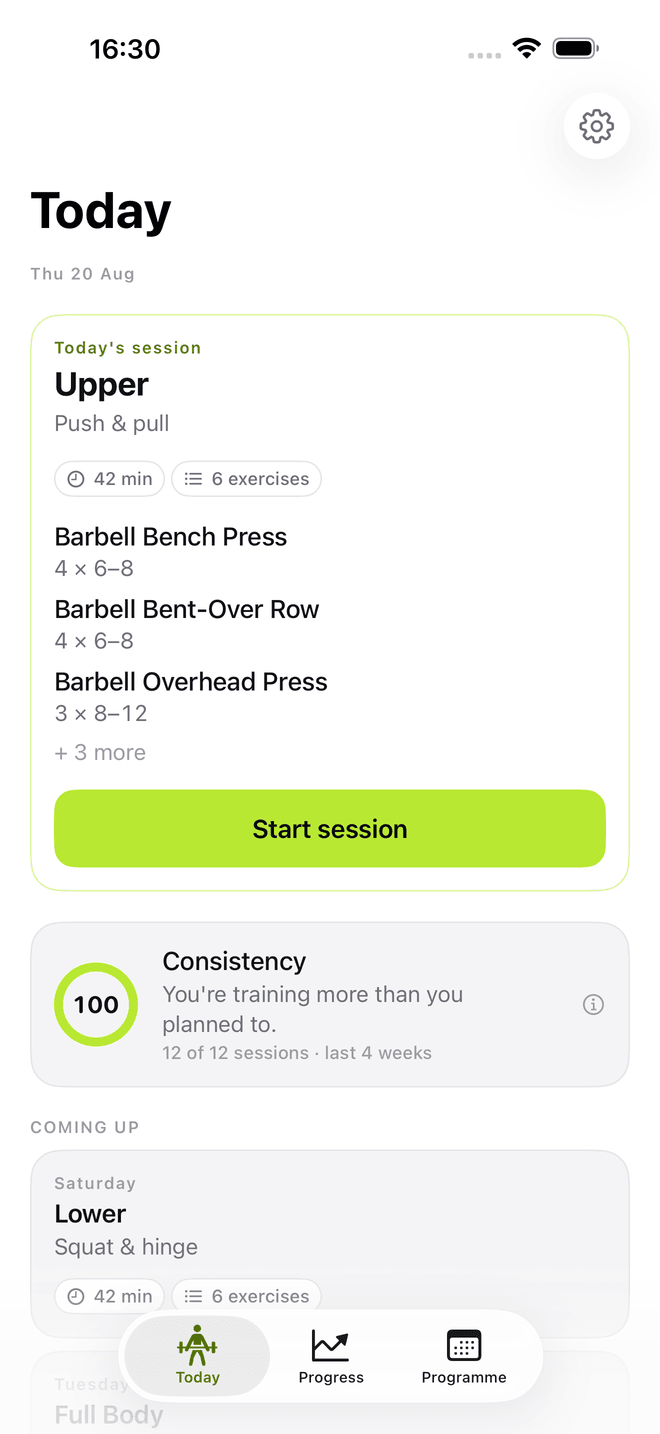
Today. Say how you feel, then train.
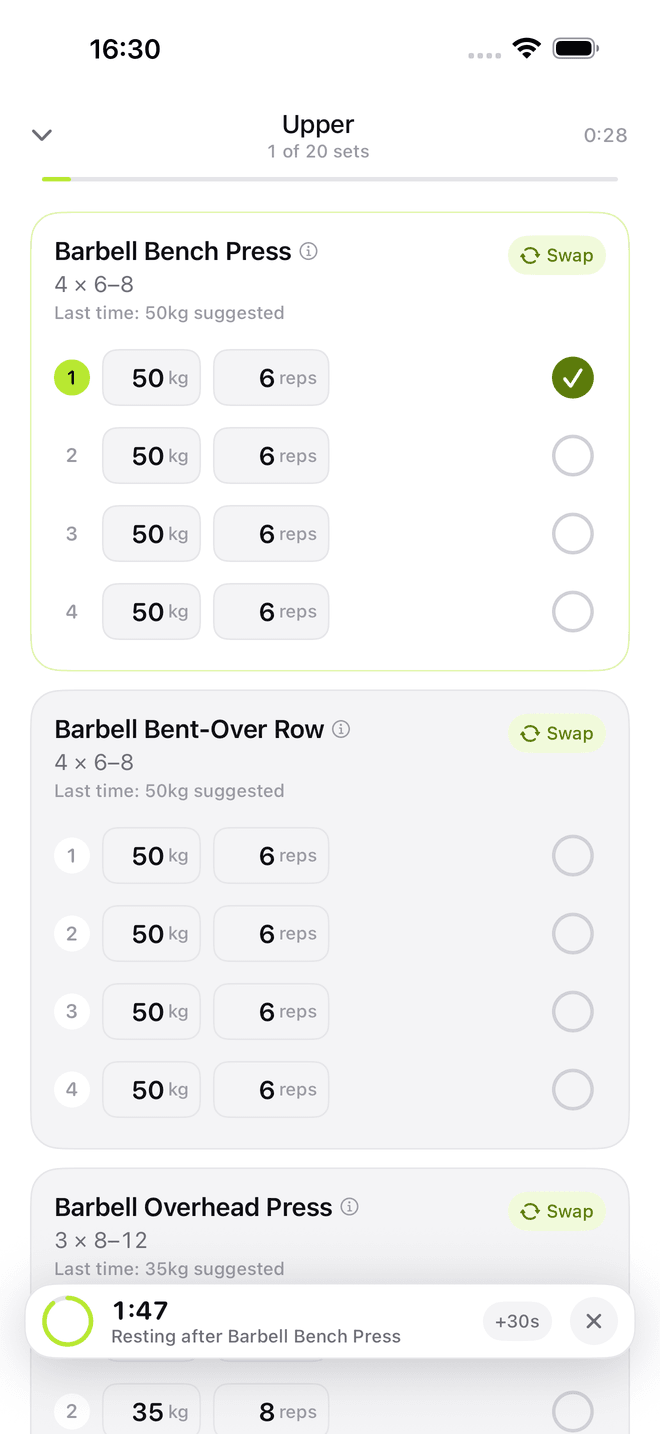
Roll the weight and reps, log, move on.
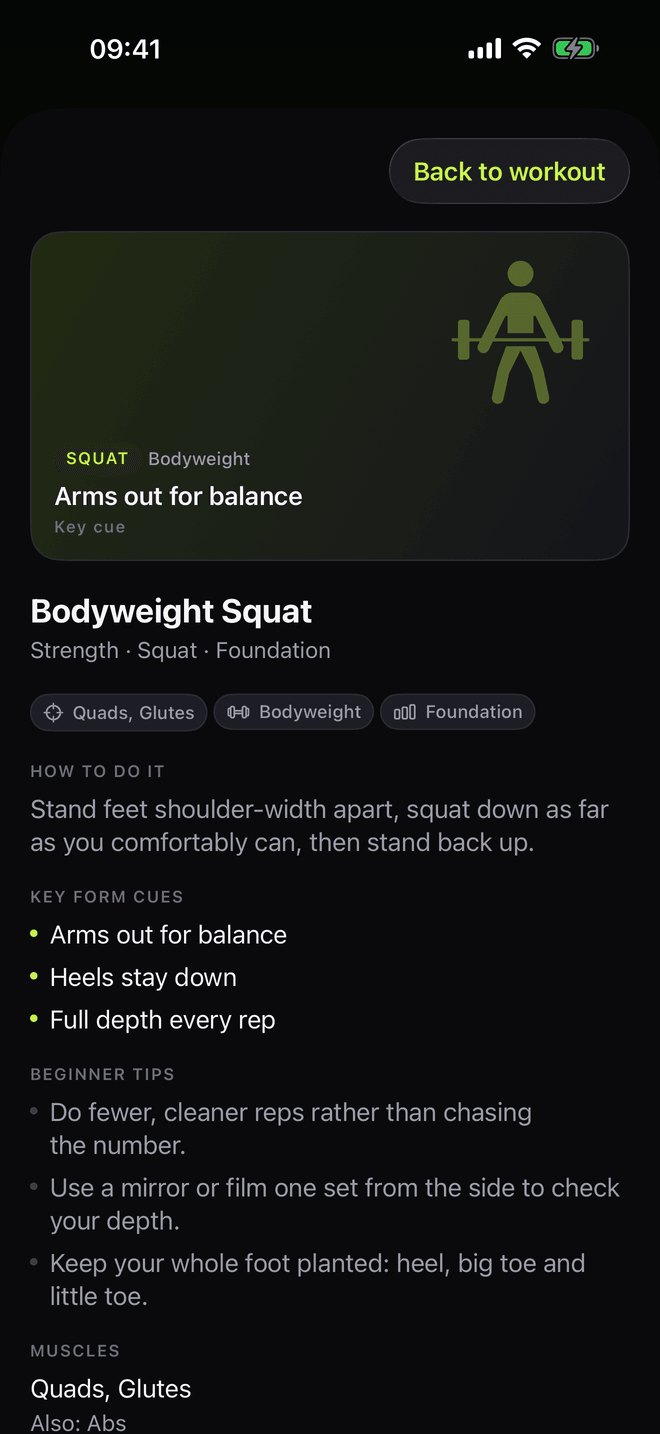
How to do it, without leaving the workout.
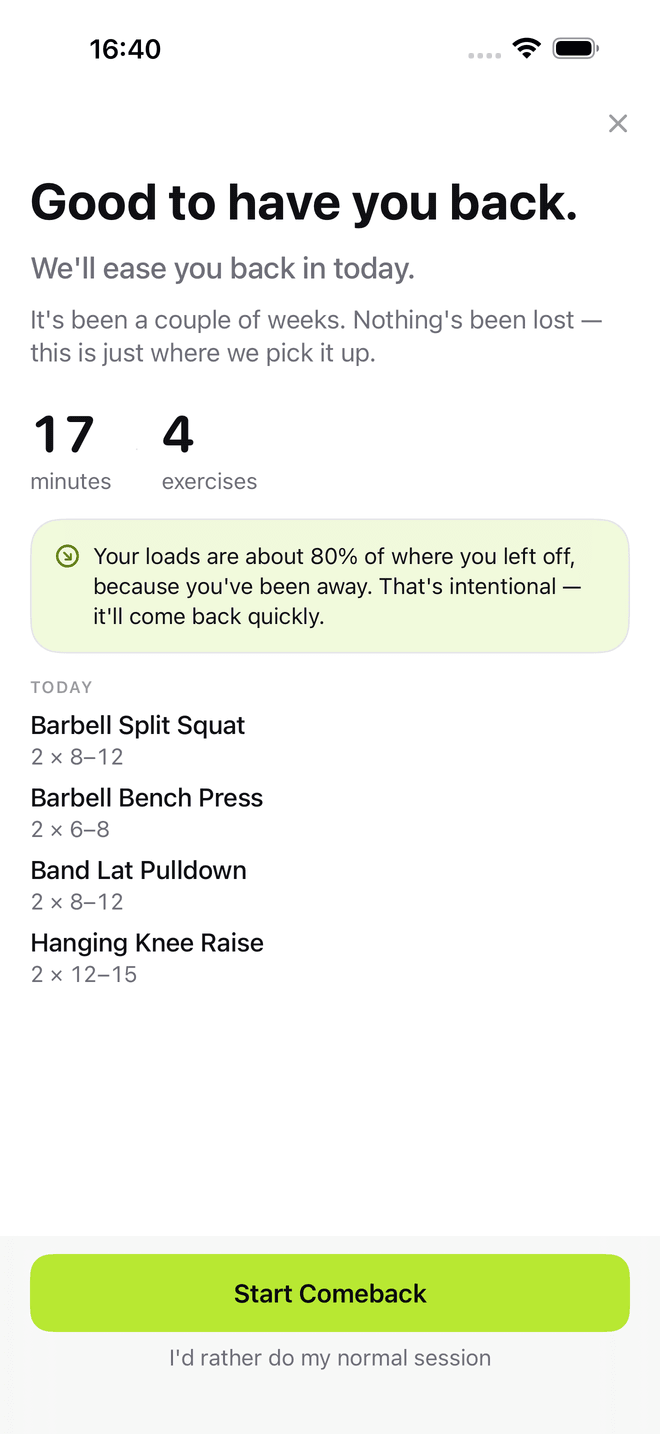
After time away, a shorter way back in.
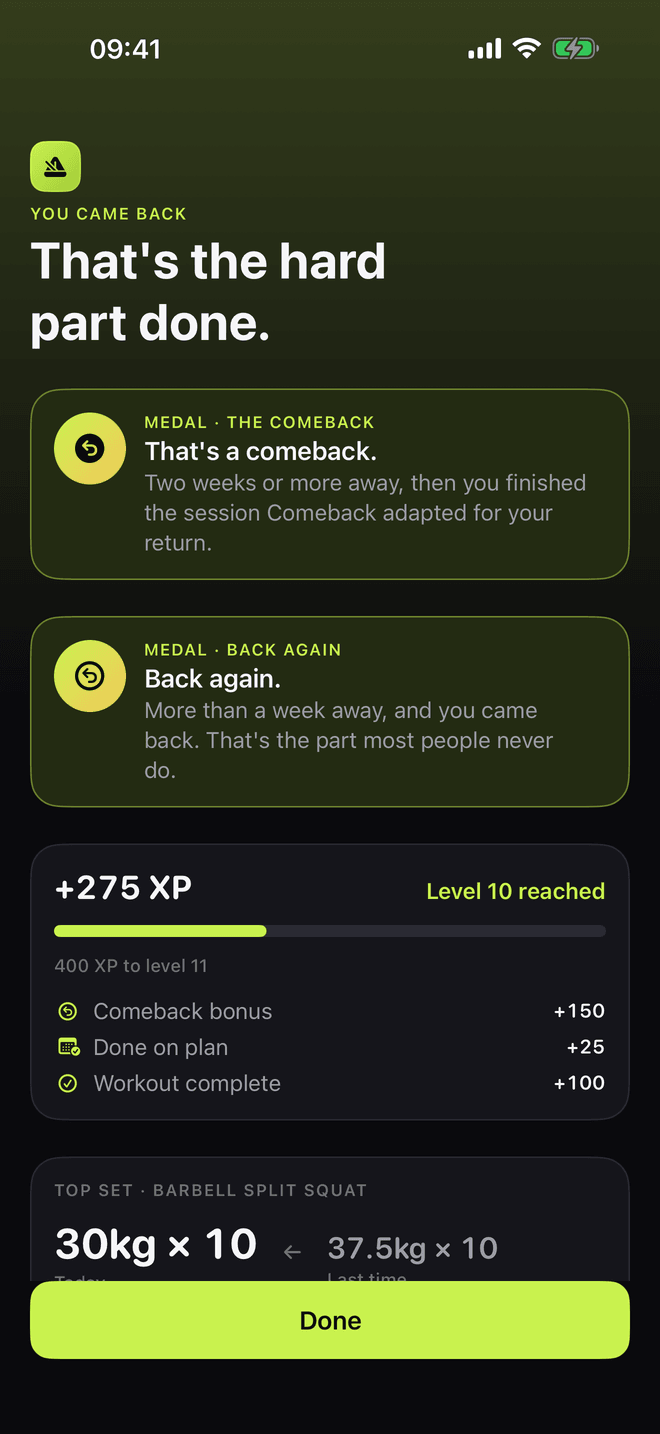
Coming back is what earns the biggest medal.
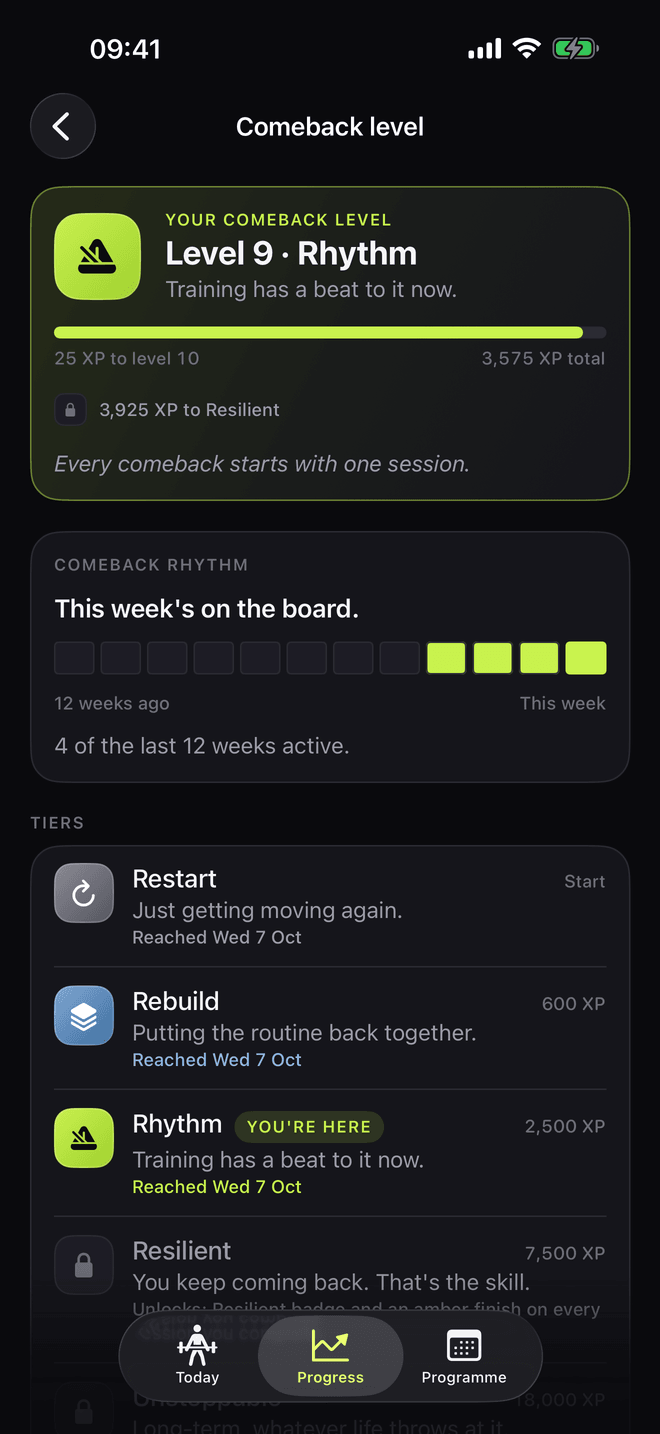
Levels and tiers for turning up, not for lifting the most.
Why Comeback
The things it refuses to do are the point.
A week off costs you nothing.
Consistency is measured over a rolling four weeks and never returns to zero. XP only ever goes up — missing a session takes nothing away — and the most valuable medals are for returning after time away. You are measured against who you were last month, never against anyone else. No leaderboards, no ads.
New to lifting? It shows you how.
Every exercise has instructions, the form cues that matter and tips for a first attempt. If you have never trained before, Comeback offers them the first time each exercise comes up in a workout, and stops offering once you've had a look.
No account. No email. No sign-up.
The app works the moment it opens. Comeback never asks for your name, your email address, your date of birth or your location, because it has nowhere to put them and no reason to want them.
It works with no signal.
Every core path is on the device: your programme, your sessions, your history and the full exercise library. iCloud is sync only, into your own private database, which we cannot read.
Your data is yours, and you can take it with you.
Export everything as a CSV file at any time, on any plan, free. Your own training history is not a paid feature. Nothing is sold to anyone, because there is nothing to sell.
142 exercises, filtered by what you can actually reach.
A curated catalogue. When you swap, Comeback offers three alternatives chosen to hold the training intent of that slot, filtered by the equipment you told it about. Deterministic rules — no AI, and never a generated exercise name.
Pricing
£7.99 a month, or £39.99 a year.
Both start with a 7-day free trial. The free tier is not a demo — you can train on it for as long as you like.
| Feature | Free | Premium |
|---|---|---|
| Programme, exercise library, “How to do it”, logging, rest timer | Unlimited | Unlimited |
| Levels, tiers and medals | Included | Included |
| Monthly volume and estimated calories | This week and month | Every period, compared fairly |
| Cool-down after a session | 5 minutes | 5 or 10 minutes |
| Next session adapts to how the last one felt | — | Yes |
| Tired, sore, short-on-time and away-from-home versions | — | Yes |
| Comeback Rescue — a slipped week re-dated | — | Yes |
| Swaps | 3 per week | Unlimited |
| Comeback plans | 1 | Unlimited |
| Personal bests and strength trends | One lift | Every lift |
| History in the app | 30 days | Unlimited |
| CSV export of all your data | Always free | Always free |
| Automatic progression | Last weight pre-filled | Steps up when you clear the range |
| Rebuild programme / change goal | — | Yes |
A free user who has already used their one Comeback plan is still welcomed back, still shown a session, and can still train indefinitely. Premium unlocks the graded plan — loads scaled from your own last recorded top set — not access to training itself.
Subscriptions are handled by Apple, and Comeback never sees your payment details. A free trial becomes a paid subscription unless you cancel at least 24 hours before it ends. You can cancel at any time on your iPhone in Settings → your name → Subscriptions, and you keep Premium until the period you have paid for runs out. Prices are in pounds sterling and include VAT where it applies.
Download Comeback
A training plan that survives your actual life. Free to start, and free to keep using.
iPhone · iOS 17.2 or later